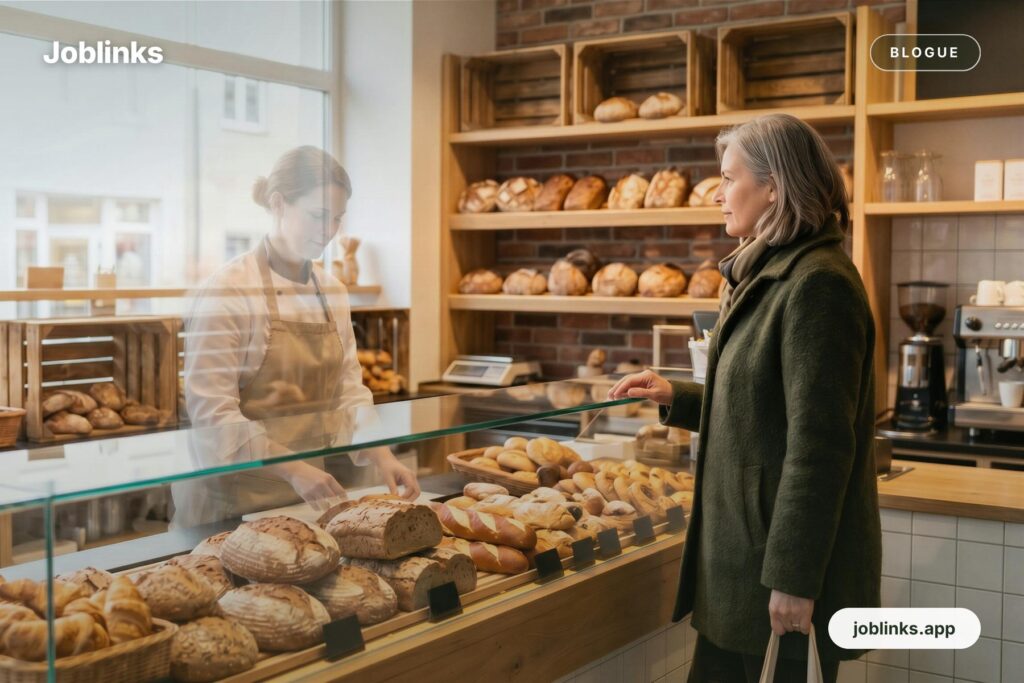
In Quebec, more than a third of retail jobs are held by young people aged 15 to 24. Yet they are the ones who respond least to job postings. They aren’t missing: in 2025, unemployment among 15 to 29 year olds reached 8.2%, compared with 5.6% for the population as a whole. They aren’t somewhere else. They looked at you before you looked at them, and they moved on.
The reversal
A 19-year-old is looking for a weekend job. She doesn’t start with your posting. She starts with your store.
Google Maps first: the photos, the reviews, the tone of the owner’s replies. Then Instagram, if there is an account: the team, or only the products? Then two or three comments from former employees, found in thirty seconds. No faces. Hours “to be discussed.” An application form that asks for a Word file.
She closes the tab. The interview has taken place. You weren’t there.
- Your Google photos and reviews, and whether the owner answers the bad ones.
- Your Instagram: faces, or only products.
- What former employees have written about you.
- Whether the hours and the pay rate are written down, or “to be discussed.”
- Whether applying takes two minutes on a phone, or a Word file and a computer.
This is the reversal many managers haven’t noticed yet: when hiring Gen Z, the employer is no longer the first to screen. She is. And she screens on what you show, not on what you write.
Hiring Gen Z: the wrong reflex
When a posting gets no response, the reflex is to make it longer. Add an employee discount, a line about the atmosphere, the words “dynamic team.” Nothing changes.
Let’s call it what it is. She doesn’t read the posting. She looks for proof. Proof is a face, a voice, specific hours, a reply within 48 hours. A list of tasks isn’t proof; it’s a wall.
Her priorities aren’t the ones people assume, either. According to Deloitte’s 2026 survey of more than 22,000 young people in 44 countries, nearly half live paycheque to paycheque. What a candidate wants to know isn’t whether you have a foosball table. It’s how many hours you guarantee, at what rate, and whether the Thursday evening shift really ends at 9 p.m. Honesty about the schedule attracts more than any perk.
Let’s also remember something the résumé hides well: in a store, people are rarely let go for a lack of technical skill. They are let go for a lack of soft skills. A cash register can be learned in two days. Welcoming customers, staying calm in front of a line, being straightforward when a product is out of stock: none of that can be written down or demanded in a posting. It has to be seen.
Who speaks in your posting
A logo convinces no one who is 20. Her future coworker at the till does.
Thirty seconds of a team member describing their day, filmed on a phone between two aisles, is worth more than any corporate video. No script. No music. A person saying why they are still there after a year, and what a Saturday in December looks like.
It’s what a video recruitment platform sees, posting after posting: when the team appears on screen, applications come in that text alone never got. Not because video is trendy. Because it answers the only question the candidate was asking: who will I be working with?
They stay if it’s true
Young people are blamed for leaving after three months. Let’s look at the first Friday night instead of the third month.
Gen Z turnover is rarely about being flighty. It’s the gap between what was promised at hiring and what was lived on the floor. A “family atmosphere” that turns out to be an absent manager. A “flexible schedule” that means available at all times. Quitting isn’t a betrayal; it’s a correction.
Video commits the employer as much as the candidate. What you film, you have to live up to. A manager who shows the real store, the real team, the Thursday shift as it actually is, hires people who have seen where they are going. They stay, because nothing surprised them.
Deloitte points to another fact: lack of recognition ranks second among the causes of burnout reported by young people, just behind workload. Recognition doesn’t start at the annual review. It starts the day someone looked at the person, not at a half-page résumé.
What a manager can show this week
Three steps, no budget.
Treat your digital storefront like your physical one: answer your Google reviews, post a photo of the team, take down the posting that asks for a cover letter. What you show online is the first interview, and it happens without you.
Write down the hours and the pay rate, in black and white. A young person working out their rent won’t apply for a “competitive salary.”
Let someone from the team speak, not head office. Thirty seconds is enough. And reply quickly: in retail, response time loses more candidates than the hourly rate.
That is exactly what Joblinks, a Quebec video recruitment platform, makes possible from a phone. The employer shows the store and the team, candidates introduce themselves on video, and both talk directly. For a manager, the difference is measured in hours: fewer empty résumés to decode, fewer exploratory interviews, and a first meeting that confirms rather than discovers.
In short
- More than a third of retail jobs in Quebec are held by 15 to 24 year olds; they aren’t missing, they are choosing.
- Gen Z evaluates your business online before reading your posting: what you show is the first interview.
- A team member on video and an honest schedule attract more than any perk, and retain better.
Gen Z isn’t ignoring you. They looked at you, and they saw nothing. What they see of your store in one minute is something you can change this week.
Your next sales associates are already watching you
Show them your team: post your first job on video and meet your candidates before the interview.
Sources and references
The data cited comes from the sources below. We invite readers to consult them to verify and explore the information presented.
- Job Bank, Government of Canada: Quebec sector profile, wholesale and retail trade (December 10, 2025). Young people aged 15 to 24 hold 34.2% of retail jobs in Quebec, compared with 13.3% across all industries. guichetemplois.gc.ca (in French)
- Government of Quebec: Un premier emploi pour toi! (May 21, 2026). Unemployment rate among 15 to 29 year olds in Quebec in 2025: 8.2%, compared with 5.6% for the population as a whole. quebec.ca (in French)
- Deloitte: 2026 Global Gen Z and Millennial Survey (May 13, 2026). 22,595 respondents in 44 countries. Nearly half live paycheque to paycheque; lack of recognition is the second most reported cause of burnout. deloitte.com